Based on John Stokes Jr.’s supplied account.

John remembers nights on deployment when he could barely keep his eyes open. Then he would finally have somewhere to lie down—and find himself awake again.
The air barely moved. Unfamiliar sounds carried through the night. Even with a safe opportunity to rest, he found it difficult to leave the pressure of the day behind.
“During deployment, I learned that being tired and being ready to sleep were two different things.”
His shoulders stayed raised. His jaw stayed tight. Conversations and decisions replayed as soon as he closed his eyes.
“I had the opportunity to sleep. What I struggled with was settling down enough to take it.”
His first response was to try harder. Stop thinking. Get comfortable. Fall asleep because tomorrow mattered.
“None of those instructions gave me anything useful to do.”
What helped, he writes, was having a sequence he could follow: release tension, settle into comfortable breathing and give his attention somewhere quieter to go.
There were still difficult nights. The routines did not remove the heat, the pressure or the need for enough sleep. But they gave him a practical way to prepare for rest.
The problem with making sleep a timed challenge
The popular military sleep method is often presented as a way to fall asleep in two minutes. That is an appealing promise when you are lying awake.
The distinction is that relaxation techniques can help prepare someone for sleep, while the complete named method and its two-minute outcome have not been established through clinical studies. Cleveland Clinic also notes that trying to hurry sleep can add pressure. [2].
John’s account focuses on a more manageable aim: get comfortable, follow a familiar sequence and stop repeatedly checking whether it has worked.
These are the four approaches he describes.
1 Start by noticing where you are holding tension
On some nights, John lay down without realising he was still clenching his teeth. Noticing that tension gave him a place to begin.
A simple version starts with getting comfortable and allowing the face to soften. Release the jaw, lower the shoulders and let the arms and hands rest. Move attention down through the legs, allowing each area to settle.
Keep breathing comfortably. Then picture somewhere peaceful—a familiar garden or a quiet lakeshore—and gently return to that scene when thoughts wander. These are common components of the popular military sleep method. [2].
“For me, the value was having something simple to return to.”
He did not need to solve tomorrow’s problems while lying in bed. He could notice that his shoulders had tightened again and let them settle.
2 Make the difference between tension and relaxation noticeable
Sometimes, simply telling himself to release tension felt too vague. John preferred a more physical exercise: briefly tightening a muscle group, then letting it go.
Progressive muscle relaxation is included in the Human Performance Resources by CHAMP guidance. Its guided sequence takes approximately 10–15 minutes. It involves moving through muscle groups, briefly holding tension and noticing the release. [4].
A comfortable introduction is to gently close the hands into fists, hold for about five seconds, then release. Continue through other comfortable muscle groups while breathing normally.
The point is to notice the difference when the muscles let go. Avoid painful areas; if you have an injury or ongoing pain, seek professional advice before trying it. HPRC suggests other relaxation approaches for people currently in pain.
“I could actually notice the looseness.”
That physical contrast gave John something clearer to work with than an instruction to calm down.
3 Give your attention a steady count
On other nights, John wanted a shorter exercise he could follow with his eyes closed.
Box breathing uses four equal phases: inhale for four seconds, hold for four, exhale for four and pause for four. U.S. Army sleep-readiness guidance describes repeating this sequence four times before bed. That recommendation does not establish a guaranteed sleep-onset time. [11].
Keep it comfortable. Avoid forcing large breaths or straining through the holds; return to normal breathing if you feel dizzy, breathless or uncomfortable.
John describes using the count to redirect his attention when he caught himself replaying the day. Sometimes he followed it with body relaxation. Sometimes he stopped there.
“You do not need to complete every exercise to earn a good night’s sleep.”
Choosing one manageable exercise kept the routine from becoming another demanding checklist.
4 Use a brief daytime rest when the circumstances allow it
The fourth approach served a different purpose. During appropriate breaks, John sometimes lay down with his lower legs supported and gave himself a short opportunity to rest.
“I was not expecting a few minutes to erase an inadequate night. I was taking an appropriate opportunity to rest.”
At home, that might mean a comfortable mat beside a sofa, with the calves supported on the seat and the knees comfortably bent. A short alarm can mark the rest period. The position should feel comfortable rather than something to endure.
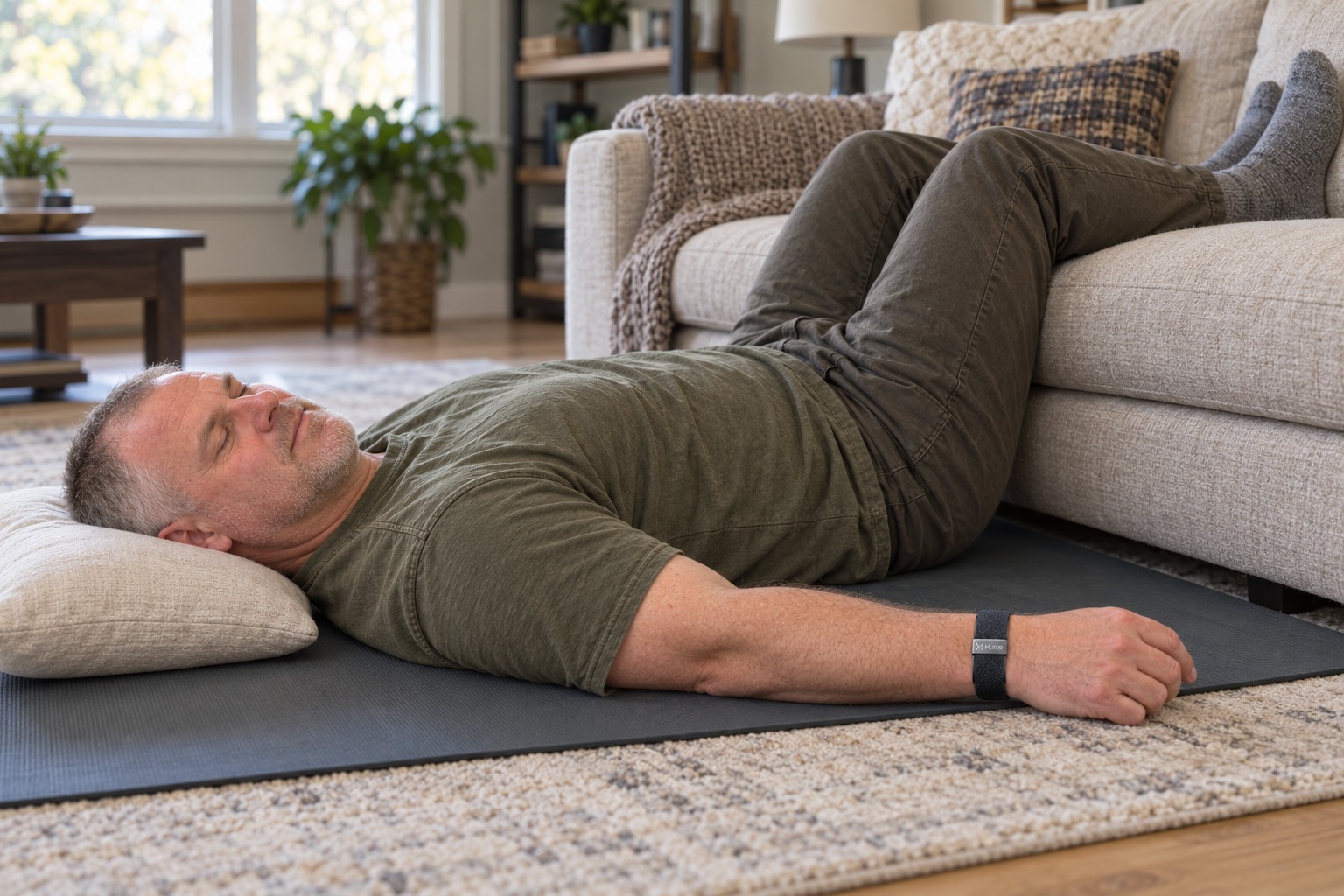
Short naps have research behind them, although that does not prove a special sleep-inducing effect from raising the legs.
In a controlled study of 24 healthy young adults following a night restricted to about five hours of sleep, a ten-minute nap produced immediate improvements in measures including sleepiness, fatigue and cognitive performance. Some benefits lasted approximately two and a half hours. Crucially, researchers measured ten minutes of actual sleep, not ten minutes from setting an alarm, and did not test the floor-based posture described here. [1].
For adults following a normal daytime schedule, NHLBI advises keeping naps brief—no more than about 20 minutes—and limiting them or moving them earlier if they interfere with bedtime. Allow any grogginess to clear before driving or doing work that demands alertness. [7], [9].
If lying flat triggers reflux, skip that position. NIDDK notes that leaving at least three hours between a meal and lying down may help people with nighttime reflux symptoms. [10].
What to do when you are still awake
Some nights remained difficult, even after following a routine.
“The most frustrating ones were the nights when I stayed there repeatedly checking whether it had worked.”
When bed becomes a place of prolonged wakefulness and frustration, stimulus-control guidance includes getting up and returning when sleepy. Quiet activity in low light is a more suitable break than work or scrolling. This approach is part of cognitive behavioural therapy for insomnia. [6].
The broader evening matters, too: enough time for sleep, consistent scheduling, quieter activities before bed and a room that is comfortably cool, dark and quiet. Caffeine can affect sleep for up to eight hours, making its timing worth considering. [7].
For persistent insomnia, multicomponent CBT-I has stronger clinical support than relying on a single relaxation exercise. The American Academy of Sleep Medicine strongly recommends it for chronic insomnia and advises against sleep hygiene as the sole treatment. [3].
Sleep problems that affect daytime functioning deserve professional attention. Loud snoring, pauses in breathing or waking up gasping also warrant assessment; a relaxation routine does not diagnose or treat sleep apnoea. [8].
“Persistent sleep problems deserve attention, not another order to try harder.”
The next question comes in the morning
John’s account centres on learning to recognise his own experience: the tight jaw, the restless thoughts, the mornings when he felt more rested.
You can begin doing that at home. Try a comfortable routine and notice how you feel afterward.
But remembering a whole week of sleep is harder. One bad night can overshadow several better ones. By Friday, the details of Monday may already be blurred.
A record gives you something to return to.
That is where Hume Band fits into the routine.
Give your nights a record with Hume Band
Wear Hume Band overnight, then review its estimates of sleep duration, stages and awake periods in the morning. Recovery, resting heart rate and heart rate variability views add further wellness context. [5].
Alongside those observations, keep a short note about your evening and how rested you feel. Then look across several nights:
- Was your sleep timing consistent?
- How did the estimated awake periods vary?
- Which evenings did you follow your wind-down routine?
- How did you feel the next morning?
Now you have more to review than a vague memory that you slept well or badly. You have your own notes alongside a record of your nights.
The routine gives you something to practise. Hume gives you sleep patterns to review.
The readings are estimates and cannot establish exactly why a night felt different. Use them as context alongside your experience; persistent sleep difficulties deserve professional attention.
John puts the bedtime goal simply:
“You do not have to prove you can sleep on command.”
Start with a routine you can repeat. Let Hume Band help you build a clearer picture of the nights that follow.
3 comments
Comments